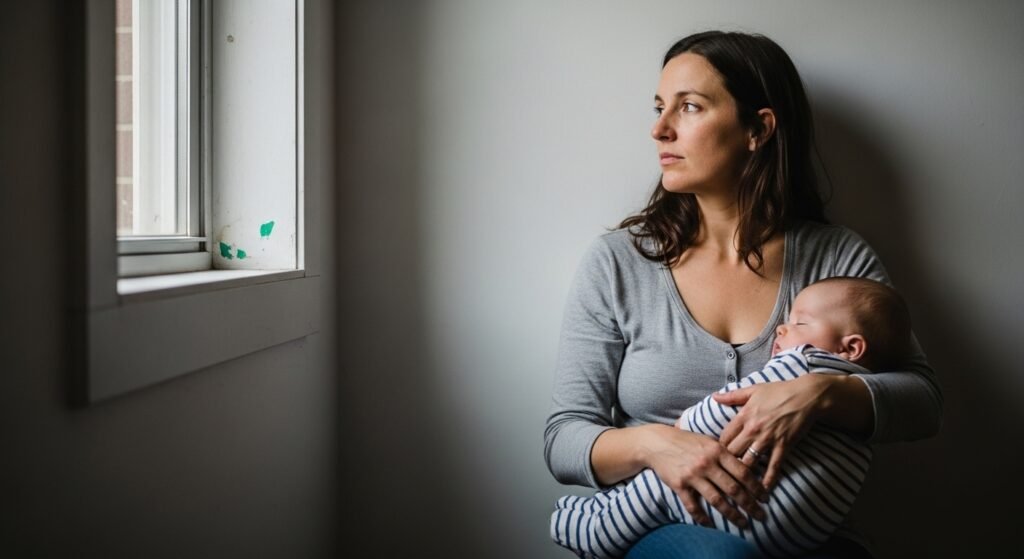
Let’s start with the lie.
Not the malicious kind. The soft, pastel-colored, Instagram-filtered lie we’ve all absorbed: that bringing a baby into the world is supposed to feel like floating on a cloud made of lullabies and unconditional love.
You’re glowing. You’re fulfilled. You’re finally complete.
And yet—there you are at 3:17 a.m., sitting on the edge of your bed, holding a crying newborn, crying yourself, wondering one quiet, terrifying thing:
What is wrong with me?
Nothing. Absolutely nothing.
What you might be experiencing is postpartum depression—and it’s far more common, complex, and human than we’re taught to admit.
The Part No One Prepares You For
We prepare for birth like it’s a marathon. Breathing techniques, hospital bags, playlists, maybe even a carefully curated “push present.” But no one really hands you a manual for what comes after—when the body is sore, the hormones are crashing, and the responsibility is… permanent.
Postpartum depression (PPD) isn’t just “feeling a little sad.” It’s not the same as the “baby blues,” which usually pass within a couple of weeks. PPD is deeper. Heavier. Stickier. It lingers like a fog that won’t lift.
And the most unsettling part? It often shows up right when you think you’re supposed to be happiest.
It Doesn’t Look the Way You Think
Forget the dramatic movie scenes.
Postpartum depression doesn’t always look like someone unable to get out of bed (though it can). Sometimes it looks like:
- Smiling at visitors while feeling completely disconnected inside
- Obsessively checking if the baby is breathing—again and again
- Snapping at your partner over something trivial, then crying in the bathroom
- Feeling numb instead of overwhelmed
- Wondering if your baby deserves a “better” mother
And sometimes, it looks like laughing at a joke while quietly thinking, I don’t recognize myself anymore.
The Guilt Is Loud. The Truth Is Louder.
If PPD had a tagline, it would be: “You’re failing.”
That voice can be relentless.
“You should be grateful.”
“Other mothers handle this just fine.”
“Your baby needs you—why can’t you just be okay?”
But here’s the truth that cuts through all that noise: postpartum depression is not a personal failure. It’s not a character flaw. It’s not something you caused by thinking the wrong thoughts or not loving hard enough.
It’s a medical condition—one influenced by hormonal shifts, sleep deprivation, physical recovery, and emotional upheaval. In other words, your brain and body are going through a storm, and storms don’t ask permission.
Why It Hits So Hard
Imagine this:
Your hormones drop faster than a phone battery on 1%. Your sleep becomes fragmented into unpredictable, bite-sized pieces. Your identity shifts overnight—from an individual to someone’s entire world.
And on top of that, society expects you to “bounce back”—physically, emotionally, socially.
That’s not just pressure. That’s a setup.
Postpartum depression often thrives in silence because it clashes so violently with the narrative we’ve been sold. Admitting you’re struggling can feel like confessing a crime no one else seems to be committing.
But they are. They just don’t always say it out loud.
The Humor We Don’t Talk About
There’s a strange, dark humor that lives in early motherhood.
Like crying because you dropped a biscuit.
Or feeling irrational rage at a onesie that won’t snap correctly.
Or Googling “why is my baby making this noise” at 4 a.m. and spiraling for 45 minutes.
It’s okay to laugh at these moments—even in the middle of tears. Humor doesn’t invalidate the struggle; sometimes it’s what helps you survive it.
If anything, those tiny absurdities are proof that you’re still there—underneath the exhaustion, still human.
The Isolation Trap
Here’s the sneaky part: postpartum depression often convinces you to withdraw.
You cancel plans. You stop replying to messages. You tell people you’re “just tired” because it’s easier than explaining the heaviness in your chest.
But isolation is where PPD grows stronger.
Connection—even imperfect, awkward, tear-filled connection—is one of the most powerful ways to push back.
That might mean:
- Telling a friend, “I’m not okay,” even if your voice shakes
- Admitting to your partner that you feel overwhelmed instead of pretending you’ve got it handled
- Speaking to a healthcare professional who actually understands what this is
You don’t have to perform strength. You just have to show up honestly.
Love Can Exist Alongside Darkness
One of the most confusing parts of postpartum depression is this:
You can love your baby deeply—and still feel miserable.
Those two truths can coexist.
You might hold your baby and feel a surge of protectiveness so strong it scares you. And then, minutes later, feel empty, exhausted, or trapped.
This doesn’t make your love fake. It makes your experience complex.
Human emotions are rarely tidy. Motherhood, especially, is a beautiful mess of contradictions.
Getting Help Isn’t Weakness—It’s Strategy
Let’s reframe something.
If your leg were broken, you wouldn’t try to “just push through” without treatment. You’d get help. You’d rest. You’d follow a plan to heal.
Your mental health deserves the same respect.
Treatment for postpartum depression can include therapy, support groups, medication, or a combination of these. And no—getting help doesn’t mean you’ve “failed naturally.” It means you’re choosing to function, to heal, to be present in your own life again.
That’s not weakness. That’s wisdom.
For the Mothers Reading This at 3 A.M.
If you’re reading this in the quiet hours—when the world is asleep and your thoughts feel louder—here’s something you need to hear:
You are not broken.
You are not alone.
And this will not last forever.
It might not disappear overnight. Healing rarely does. But with the right support, the fog can lift. Colors can come back. Laughter can feel real again.
And one day, you might look at your baby—not through a haze of exhaustion and self-doubt—but with clarity, steadiness, and a quiet kind of joy that doesn’t need to be loud to be real.
The Conversation We Need to Keep Having
Postpartum depression thrives in silence—but it weakens when we talk about it openly, honestly, and without shame.
So let’s keep saying the uncomfortable things:
- That motherhood isn’t always magical
- That mental health matters just as much as physical recovery
- That struggling doesn’t make someone a bad parent
Because the more we normalize these truths, the more space we create for mothers to breathe, to heal, and to feel seen.
And if no one has told you this today:
You’re doing better than you think. Even on the days it doesn